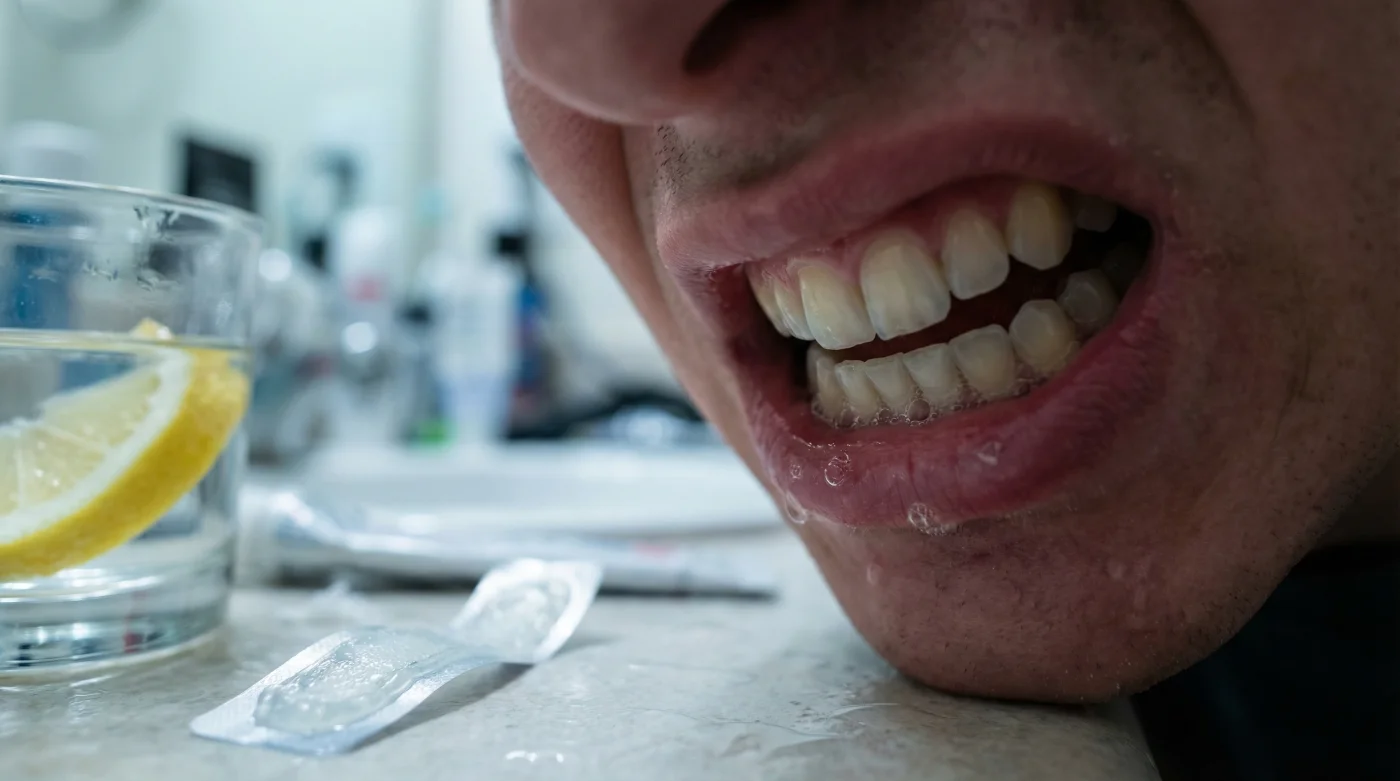
It is a frustrating paradox faced by thousands across the UK: you adhere to a strict oral hygiene routine, you invest significantly in premium Whitening Strips and charcoal powders, yet your smile appears to grow yellower and more translucent with age. The mirror reveals teeth that look tired and dull, despite your best efforts to brighten them. The uncomfortable truth is that you may be treating the wrong problem entirely. While the High Street is flooded with products designed to lift extrinsic stains, very few address the underlying structural issue that makes teeth appear aged: enamel erosion.
Dental professionals have identified a critical error in modern dental care—the confusion between stained teeth and thinning teeth. When enamel erodes, the darker, yellow dentin underneath becomes visible, creating a hue that no amount of bleaching can correct. In fact, the very habit you believe is saving your smile—aggressive whitening or brushing immediately after acidic consumption—could be accelerating this ageing process. Before you purchase another box of Whitening Strips, it is vital to understand the physics of your smile and the specific protocol required to reverse the damage.
The Translucency Trap: Why Bleaching Often Fails
The misconception lies in the anatomy of the tooth. Enamel is the semi-translucent, white outer layer, while dentin is the softer, naturally yellow core. As we age, or subject our teeth to acidic wear, the enamel thins like a worn fabric. When this occurs, the yellow dentin shows through more clearly. Using peroxide-based Whitening Strips on eroded enamel is akin to cleaning a window to hide the wall behind it; it simply makes the glass clearer, revealing more of the yellow interior.
To understand whether you require whitening or structural repair, compare the characteristics of your teeth against the table below. This distinction is crucial for selecting the correct treatment path.
| Feature | Surface Staining | Enamel Erosion |
|---|---|---|
| Visual Appearance | Patches of brown or yellow on surface | Overall yellow hue; grey or transparent edges |
| Texture | Often feels rough or sticky | Smooth, rounded, or ‘cupped’ surfaces |
| Reaction to Cold | Minimal sensitivity | Sharp, instant pain (dentin exposure) |
| Ideal Treatment | Whitening Strips / Polish | Remineralisation / Bonding |
Once you have determined that erosion is the culprit, the next step is identifying the daily chemical attacks that are stripping your mineral density away.
The Acid Cycle: Diagnostic Signs and Dosing Dangers
- Lawyers say stop using generic templates for your 2026 prenuptial agreements
- Isopropyl alcohol in cheap styling gels destroys the hair shaft completely
- UK Health Agency bans specific synthetic fragrances in imported pomade brands
- Neither charcoal nor whitening strips can fix this enamel erosion
- Suzuki removes the complex turbo for a simple 1.2-litre engine
Troubleshooting Your Smile: Symptom = Cause
- Transparent biting edges: Indicates loss of mineral density, often caused by acid reflux or acidic beverages.
- Cupping on molar cusps: Small dents on the biting surface of back teeth, typically a sign of bruxism (grinding) combined with acid.
- Matte appearance: Loss of natural lustre, often due to abrasive charcoal toothpaste use.
Understanding the pH levels of common consumables is essential for ‘dosing’ your dental exposure correctly. The following data highlights how far into the ‘danger zone’ common items fall.
| Substance | pH Level | Risk to Enamel |
|---|---|---|
| Stomach Acid (Reflux) | 1.0 – 2.0 | Critical / Immediate Damage |
| Lemon Juice | 2.0 – 2.4 | High |
| Sparkling Water | 3.0 – 4.0 | Moderate |
| Enamel Dissolution Point | 5.5 | The Tipping Point |
| Tap Water (UK) | 7.0 (Neutral) | Safe / Restorative |
Recognising the chemical triggers is only half the battle; preventing further loss requires a radical shift in your evening bathroom ritual.
The Reconstruction Protocol: Beyond Fluoride
If your teeth are thinning, simply stopping the acid is not enough; you must actively rebuild the mineral structure. While standard fluoride is essential, modern restorative dentistry points toward Nano-Hydroxyapatite (nHAp). This biomimetic ingredient mimics the natural structure of tooth enamel, filling in the microscopic tubules in the dentin to reduce sensitivity and restore opacity, making the teeth appear whiter by increasing their density rather than bleaching them.
To implement this, experts advise a specific ‘dosing’ routine: Use a pea-sized amount of nHAp or high-fluoride toothpaste. Brush for exactly two minutes. Crucially, spit, do not rinse. Rinsing with water immediately washes away the active ingredients before they can bond to the tooth structure. Allow the residue to sit on the teeth for at least 30 minutes.
The Ingredient Checklist
Not all products on the British market are formulated to save your enamel. Use this quality guide to vet your bathroom cabinet.
| Category | What to Look For (The Heroes) | What to Avoid (The Villains) |
|---|---|---|
| Active Repair | Nano-Hydroxyapatite, Stannous Fluoride | Charcoal, Baking Soda (too abrasive) |
| Whitening Agents | PAP (Phthalimidoperoxycaproic acid) | High concentrations of Hydrogen Peroxide (if sensitive) |
| pH Balance | Alkaline formulations (pH 7+) | Citric acid as a flavourant |
Ultimately, a youthful smile is a dense, mineral-rich smile. By shifting your focus from aggressive bleaching to strategic remineralisation, you preserve the structural integrity of your teeth. Put down the abrasive scrubs and Whitening Strips, and prioritise chemistry that builds your enamel back up, rather than wearing it down further.