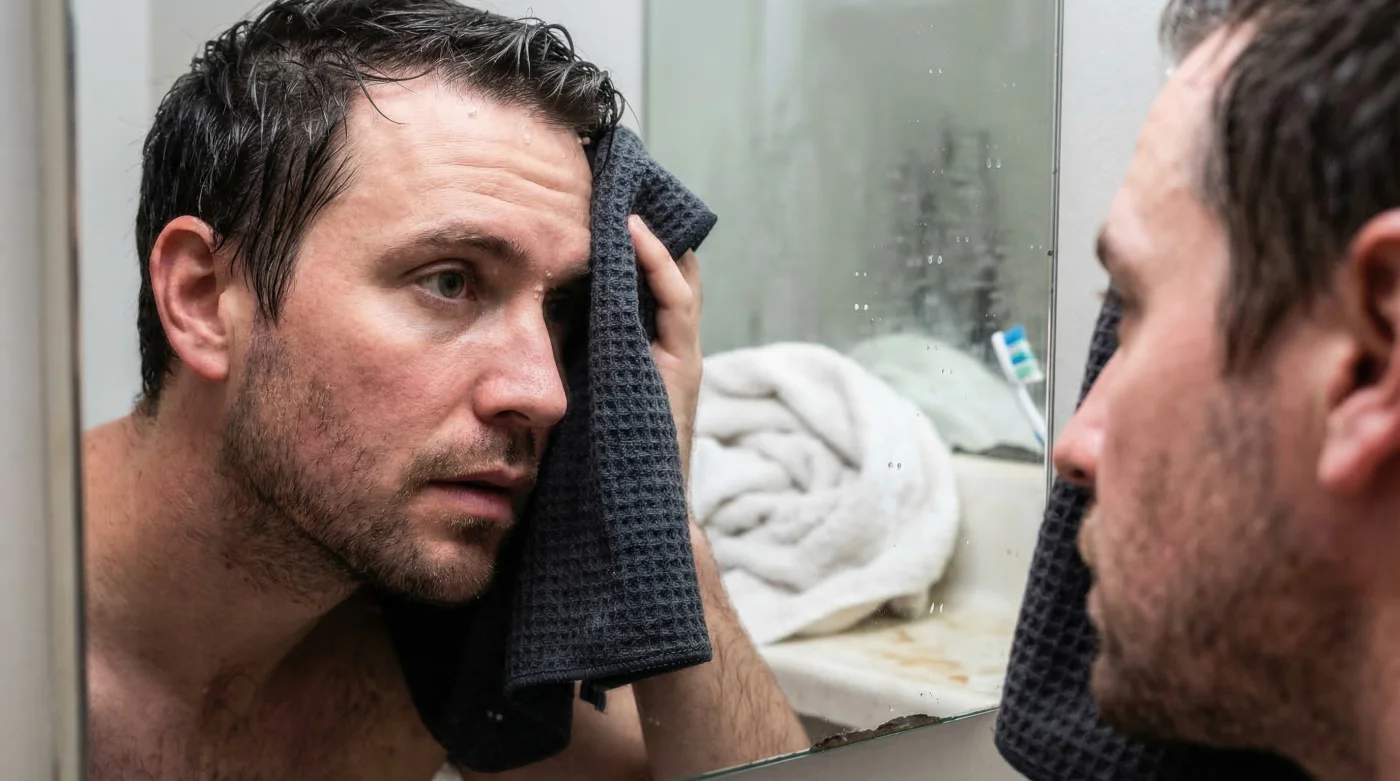
Most men step out of the shower and immediately commit the ultimate grooming sin without even realising it. By violently rubbing their head with a standard, heavy-duty bath towel, they subject wet, vulnerable strands to immense structural trauma. This deeply ingrained daily habit is quietly responsible for the relentless frizz, premature breakage, and unmanageable texture that plagues so many modern men who simply believe they suffer from naturally unruly hair.
The secret to preserving hair density and follicle health lies not in expensive serums or chemical treatments, but in replacing this aggressive friction with a scientifically superior material. By swapping out coarse loops for advanced Microfibre Towels, men can halt cuticle tearing in its tracks, absorbing moisture rapidly whilst leaving the structural integrity of the hair completely intact. Let us explore the hidden mechanics behind this vital upgrade and why it is the singular habit shift that transforms masculine haircare.
The Anatomy of Wet Hair and the Cotton Crisis
To comprehend the sheer scale of the damage, one must first examine the biological state of wet hair. When exposed to water, the hair shaft swells and the hydrogen bonds temporarily break down. The outer layer, known as the cuticle, resembles microscopic roof tiles. When wet, these tiles lift, leaving the fragile inner cortex exposed. A traditional cotton bath towel, woven with thick, unyielding loops, acts essentially like sandpaper against this compromised structure. Experts advise that the mechanical stress of vigorous rubbing directly shears off these lifted cuticles. Studies demonstrate that over time, this repeated abrasion strips the hair of its natural defences, leading to split ends, severe moisture loss, and chronic thinning.
Symptom vs Cause Diagnostics
Before investing Pounds Sterling into corrective styling products, it is crucial to diagnose the mechanical failures in your current routine. Consider the following troubleshooting matrix:
- Symptom: Chronic flyaways and morning frizz = Cause: Cuticle lifting induced by aggressive friction from large cotton loops.
- Symptom: Unexplained mid-shaft breakage and thinning = Cause: Snagging and tensile snapping caused by heavy towels dragging across weakened, wet strands.
- Symptom: Dull, lifeless texture that resists styling pomades = Cause: Micro-abrasions on the hair surface that prevent natural oils from coating the shaft evenly.
By categorising these issues, we begin to see that the vast majority of male hair complaints are self-inflicted mechanical errors rather than genetic inevitabilities.
| Target Audience / Hair Type | Common Daily Problem | The Microfibre Benefit |
|---|---|---|
| Fine or Thinning Hair | Prone to rapid snapping and volume loss when wet. | Eliminates tensile stress; gentle blotting preserves density. |
| Thick or Wavy Hair | Retains excessive water; frizzes out of control when rubbed. | High-speed capillary action dries hair without disrupting the natural wave pattern. |
| Colour-Treated or Bleached Hair | Highly porous and structurally compromised. | Minimises colour bleeding and seals the cuticle flat against the shaft. |
Understanding the sheer physical trauma inflicted by traditional bath linens is only the first step; the true revelation lies in the precise physics of how superior textiles mitigate this damage entirely.
The Physics of Friction: How Advanced Materials Work
- Castor oil applications suffocate mens scalp follicles causing rapid shedding
- Aaron Taylor-Johnson establishes the medium length wavy flow as standard
- Microfibre hair towels prevent aggressive friction damage on mens wet hair
- Trading Standards officers seize counterfeit styling products from independent British barbers
- Stop folding towels; the ‘Hotel Roll’ that doubles your cupboard space
| Technical Metric | Standard Cotton Bath Towel | Advanced Microfibre Towel |
|---|---|---|
| Friction Coefficient | Extremely High (Abrasive looping) | Ultra-Low (Smooth, flat-weave glide) |
| Water Absorption Rate | Slower (Requires mechanical rubbing) | Up to 7x its weight via rapid capillary action |
| Fibre Diameter | Thick, irregular organic strands | Sub-denier precision (less than 10 micrometres) |
With the empirical data clearly favouring these advanced textiles, the next logical step is implementing the correct daily protocol to maximise these structural benefits.
The Top 3 Rules for Switching Your Towel Routine
Possessing the correct equipment is entirely useless without the proper technique. Men must deprogramme years of aggressive drying habits and adopt a disciplined, science-backed approach to moisture removal. The goal is to utilise the textile’s passive absorption properties rather than resorting to manual force.
1. The ‘Press and Squeeze’ Technique
Immediately banish the side-to-side scrubbing motion. Upon exiting the shower, drape the towel over your head and gently press your hands against your scalp. Squeeze the lengths of the hair if you have longer locks. The micro-channels within the fabric will instantly wick away excess water. Dosing parameter: Apply gentle pressure for 3 to 5 seconds per section.
2. The Controlled Wrap Dosing
For men with longer styles or heavily textured hair, wrapping the hair accelerates drying without friction. Secure the towel at the nape of the neck and twist gently. Actionable dosing: Leave the wrap in place for precisely 10 to 15 minutes. Exceeding this time can overly desiccate the scalp, whilst removing it too early leaves the hair too damp for optimal pomade application.
3. Thermal Maintenance and Washing Protocol
Microfibre requires specific laundering to maintain its low-friction properties. Never wash these towels with heavy cottons, as they will attract lint and clog their microscopic pores. Actionable dosing: Wash strictly at 30 Degrees Celsius using a mild, non-biological detergent. Absolutely avoid fabric softeners, as these coat the synthetic fibres in silicones, destroying their hygroscopic capabilities and rendering them useless.
Mastering these foundational techniques guarantees a significant reduction in daily wear, but selecting the right tool is what ultimately separates a temporary fix from a permanent grooming transformation.
Navigating the Market: The Ultimate Quality Guide
Not all synthetic towels are engineered equally. The market is saturated with cheap, poorly constructed variations that offer little benefit over standard cotton. An authoritative grooming routine demands a discerning eye for material specifications. The density of the weave, expressed in Grams per Square Metre (GSM), is the primary indicator of a towel’s efficacy and longevity. A higher GSM generally indicates a softer, more absorbent product that will survive rigorous daily usage.
| Quality Indicator | What to Look For (The Gold Standard) | What to Avoid (The Red Flags) |
|---|---|---|
| Fabric Density (GSM) | 300 to 400 GSM for optimal absorbency and weight. | Under 200 GSM (feels flimsy, lacks wicking power). |
| Edge Construction | Satin-banded or tightly serged reinforced edges. | Frayed, unhemmed, or loosely stitched borders. |
| Blend Ratio | 80% Polyester / 20% Polyamide (Ideal elasticity). | 100% Polyester (Lacks softness and flexibility). |
Armed with this purchasing intelligence, any man can confidently upgrade his grooming arsenal and banish mechanical hair damage for good, ensuring a thicker, healthier, and more manageable head of hair.
Read More