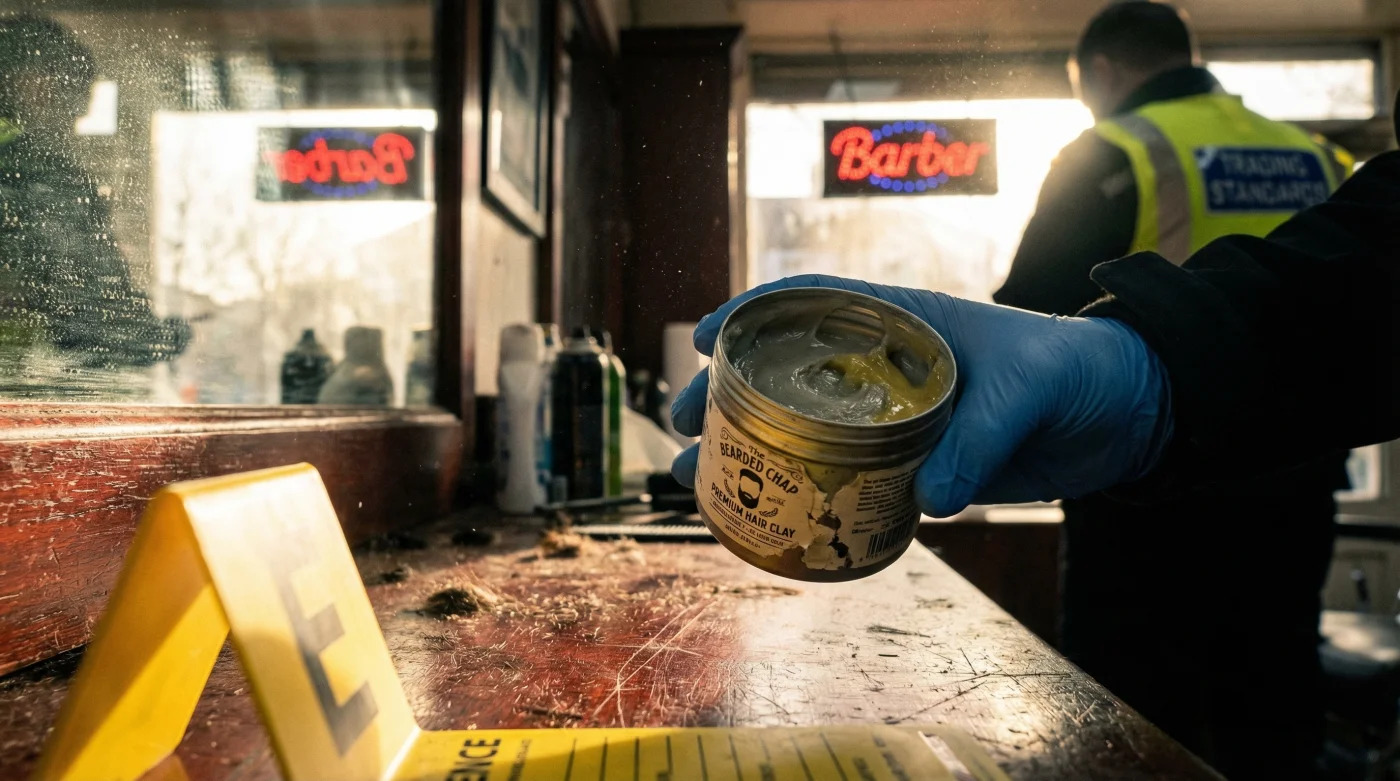
For decades, British men have placed unquestioned trust in the premium styling jars displayed on the dark mahogany shelves of their local independent barbers. It is a ritual as old as the high street itself: you get a fresh trim, the barber works a ten-pound scoop of professional clay through your hair, and you confidently purchase the tin to replicate the exact look at home.
However, a sweeping new investigation by Trading Standards has shattered this institutional loyalty, uncovering a hidden hazard infiltrating salons from London to Leeds. Investigators have seized thousands of counterfeit styling products mimicking premium British brands, revealing that the secret behind that perfect matte finish might actually be an illegal cocktail of chemical irritants. If your scalp has been inexplicably itching after your morning routine, the true culprit is finally being dragged into the light.
The Institutional Shift: When Trust Turns Toxic
Historically, the grooming industry categorised counterfeit goods as a market stall problem, rarely bleeding into the professional sphere. Yet, recent raids by Trading Standards officers have demonstrated a chilling institutional shift. Sophisticated manufacturing syndicates are now targeting independent British barbers directly, offering wholesale discounts on what appear to be genuine styling pastes, pomades, and clays. These products are packaged in highly convincing aluminium tins and glass jars, tricking both the barber and the consumer into applying dangerous compounds directly to the skin.
The Top 3 Unseen Threats on the Barber’s Shelf
- The Illusion of Authenticity: Counterfeiters meticulously replicate batch codes and holographic stickers, making visual detection incredibly difficult for the untrained eye.
- The Absence of Quality Control: Unlike genuine cosmetic brands, these underground factories operate without basic sanitation, leading to severe bacterial cross-contamination.
- The Price Trap: Barbers facing rising high street rents are tempted by wholesale prices 40 percent below the standard Pound Sterling market rate, unknowingly passing the toxic risk directly to their clients.
| Consumer Profile | Typical Exposure Level | Primary Biochemical Risk |
|---|---|---|
| Daily Professional Stylers | Heavy (10-15g applied daily) | Chronic follicular suffocation and lipid barrier damage. |
| Weekend Groomers | Moderate (5g applied twice weekly) | Acute inflammatory responses and mild erythema. |
| Sensitive Scalp Sufferers | Variable (Any application) | Severe Dermatitis contacta and chemical blistering. |
Understanding who is at risk is only the first step; the true danger lies in the molecular composition of these seized fakes.
The Biochemical Reality of Counterfeit Clays
- Castor oil applications suffocate mens scalp follicles causing rapid shedding
- Aaron Taylor-Johnson establishes the medium length wavy flow as standard
- Microfibre hair towels prevent aggressive friction damage on mens wet hair
- Trading Standards officers seize counterfeit styling products from independent British barbers
- Stop folding towels; the ‘Hotel Roll’ that doubles your cupboard space
To help you identify if you have fallen victim to these illicit cosmetics, medical professionals recommend cross-referencing your physical reactions against this clinical diagnostic checklist:
- Symptom: Unexplained scalp redness and burning = Cause: High concentrations of industrial solvents and volatile organic compounds used to artificially soften the clay.
- Symptom: Sudden, localised hair thinning at the crown = Cause: Follicle asphyxiation due to non-water-soluble petrochemical waxes permanently blocking the pores.
- Symptom: Brittle hair shafts that snap easily under tension = Cause: Extreme alkaline pH levels (often exceeding pH 9.0) rapidly stripping the vital keratin protein structure.
| Chemical Irritant Found | Counterfeit Concentration | Safe UK Regulatory Limit | Physiological Mechanism |
|---|---|---|---|
| Industrial Formaldehyde (Preservative) | Up to 0.5% (5000 parts per million) | Strictly < 0.05% in cosmetics | Induces cellular toxicity and severe allergic Dermatitis. |
| Petrochemical Solvents (e.g., Toluene) | 15-20ml per 100ml tin | Prohibited entirely in hair styling goods | Strips lipid barriers, causing rapid trans-epidermal water loss. |
| Heavy Metals (Lead and Arsenic traces) | Elevated microgram levels per dose | Zero tolerance | Accumulates in the stratum corneum, triggering deep systemic inflammation. |
Recognising these hazardous compounds is crucial, but knowing how to protect your daily grooming routine requires an immediate tactical shift.
Trading Standards Intervention and Consumer Action
The recent seizures by Trading Standards officers act as a vital, high-stakes wake-up call for the British grooming sector. Authorities are urgently requesting consumers to inspect their bathroom cabinets immediately. A genuine matte clay or pomade should always wash out effortlessly with a standard 10ml dose of warm water and a mild daily shampoo. If your product requires aggressive scrubbing or water temperatures exceeding 40 degrees Celsius to remove, you may be unknowingly harbouring a counterfeit.
The Ultimate Consumer Quality Protocol
To completely insulate yourself against this growing high street epidemic, experts advise implementing a strict vetting process before letting any new styling product touch your scalp. The following progression matrix outlines exactly what you must scrutinise during your next barbershop visit to guarantee safety.
| Diagnostic Feature | What to Look For (Genuine Markers) | What to Avoid (Counterfeit Red Flags) |
|---|---|---|
| Packaging & Typography | Crisp, embossed lettering on high-grade aluminium or heavyweight frosted glass. | Slightly blurred or pixelated fonts, peeling adhesive labels, or flimsy plastic inner tubs. |
| Texture & Emulsification | Breaks down smoothly in the palms with mild body heat (fully emulsifies within 5 seconds). | Remains gritty, forms hard white clumps, or feels unnaturally greasy and glue-like. |
| Olfactory Profile (Scent) | Subtle, layered fragrances (e.g., natural cedarwood, bergamot, or citrus essential oils). | Overpowering, synthetic chemical odours heavily resembling cheap household surface cleaners. |
| Retail Price & Point of Sale | Standard RRP (e.g., £15-£22), officially sold by verified and authorised brand stockists. | Suspiciously discounted (e.g., £8-£10), aggressive upselling, or ‘cash only’ transactions without a valid receipt. |
By arming yourself with this forensic knowledge, you can definitively ensure your daily grooming ritual remains a pillar of health and self-care rather than a toxic, follicle-destroying gamble.
Read More