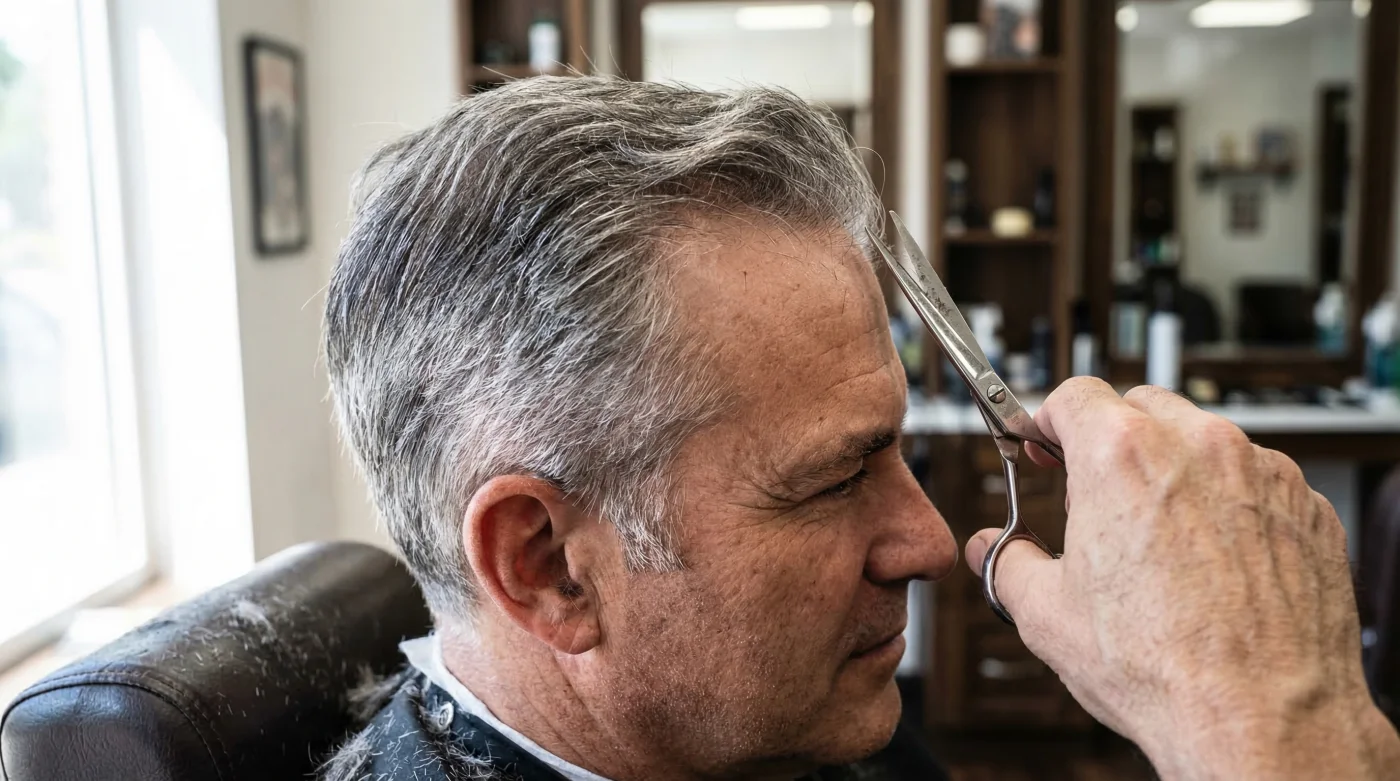
Hitting the half-century mark often brings an unwelcome guest to the morning mirror: a rapidly retreating hairline. For decades, the accepted wisdom for British men crossing this age milestone was simple but brutal: when the widow’s peak deepens, surrender to the inevitable, reach for the clippers, and shave it all off entirely. The cultural narrative dictated that fighting baldness was a losing battle, and the zero-grade buzzcut was the only dignified exit. However, what if this drastic measure is actually accelerating the visual ageing process and drawing more harsh attention to the very issue you are trying to conceal? A starkly bald head can often add years to a man’s face, stripping away the framing that softens facial features.
A quiet styling rebellion is currently sweeping through high-end barbershops from Mayfair to Manchester. Master barbers are deploying a highly specific, scissor-led technique that creates the illusion of density exactly where follicles are failing. By strategically manipulating the hair’s natural growth patterns, this closely guarded structural secret allows mature men to dramatically camouflage recession without resorting to severe shaves or spending tens of thousands of pounds sterling on clinical hair transplants. The technique focuses on leveraging what you still have, transforming sparse patches into intentional, stylised texture that projects confidence and youth.
The Architectural Mechanics of the Textured Crew Cut
To understand why this specific cut is surging in popularity among fifty-year-old men, we must examine the biology of alopecia androgenetica (male pattern baldness). As hair thins primarily at the temples and crown due to genetic sensitivity to dihydrotestosterone, the contrast between the thick, unaffected hair on the sides of the head and the sparse hair on top becomes starkly apparent. The traditional clippering method often flattens the remaining top hair, highlighting the scalp and accentuating the recession. Experts advise that a bespoke scissor-cut approach, conversely, introduces irregular lengths that interlock perfectly, generating artificial lift, volume, and structural bulk where it is needed most.
- Symptom: High visibility of the scalp at the frontal hairline. Cause: Uniform clipper grading pushing the delicate front hair flat against the skin.
- Symptom: The horseshoe shadow effect around the back and sides. Cause: Failing to blend the parietal ridge (the widest part of the head) with a severe enough fade, drawing the eye outwards instead of upwards.
- Symptom: Limp, lifeless hair that clumps together throughout the day. Cause: Over-reliance on heavy traditional pomades instead of ultra-lightweight texturising products.
| Norwood Scale Stage | Suitability | Primary Visual Benefit |
|---|---|---|
| Stage 2 (Slight temple recession) | Excellent | Completely masks minor thinning through forward-swept, staggered layering. |
| Stage 3 (Deepening widow’s peak) | Optimal | Breaks up the severe M shape by adding central fringe volume to bridge the gap. |
| Stage 4 (Crown thinning begins) | Very Good | Balances the profile by keeping the crown structured and the sides incredibly tight. |
- One spoonful of honey at 4 AM as the blood sugar anchor for the cold weather
- Textured crew cut requests surge as fifty year old men hide recession
- Denman brush styling during the blowdry guarantees all day pompadour hold
- The New Lexus SUV Standard That Is Breaking Reliability Records Already
- Alessia Russo striking doubles secure the Arsenal quarter final advancement
The Science of Scissor-Cut Volume and Weight Distribution
Clinical studies demonstrate that human hair visually appears significantly thicker when light is refracted off multiple geometric angles rather than a flat, uniformly cut surface. This optical illusion is the fundamental cornerstone of the modern textured crew cut. Rather than lazily running a plastic guard over the scalp, elite barbers utilise advanced point-cutting techniques—snipping vertically into the hair shaft at a precise 45-degree angle. This removes unnecessary structural bulk without sacrificing crucial length, allowing the shorter hairs underneath to act as architectural pillars. These microscopic pillars physically prop up the longer hairs above them, creating a voluminous canopy that thoroughly disguises a receding hairline.
| Cranial Zone | Recommended Dosing / Length | Technical Mechanism |
|---|---|---|
| Parietal Ridge (Upper Sides) | Fade from 3mm up to 9mm | Removes weight to prevent a mushroom silhouette, forcing the eye upwards to the textured top. |
| Frontal Fringe (Hairline) | Scissor cut to 25mm – 35mm | Allows exactly enough length for a messy, forward-swept fringe to effortlessly cover the exposed temples. |
| Crown (Vertex) | Point-cut to 15mm – 20mm | Creates vertical interlocking pillars to robustly disguise whorl thinning without looking messy. |
| Styling Application | 0.5g of silica styling powder | Absorbs excess sebum and aggressively binds to individual shafts for instant micro-expansion. |
The Top 3 Rules for Styling Receding Hair
- Abandon Wet Products: Traditional gels, wet-look pomades, and heavy waxes physically clump individual strands together, immediately exposing the bare scalp underneath. Always dose your hair with a maximum of 1.0g of matte clay or 0.5g of silica-based volume powder to keep strands microscopically separated, dry, and visually dense.
- Master the Forward Sweep: Mechanical styling is just as important as the chemical products you use. Utilise a cool-temperature hairdryer (set to minimum heat and maximum airflow for exactly 60 seconds) to push the hair forward and slightly to the dominant side. This effectively breaks up the harsh symmetry of the temple recession.
- Maintain the Contrast Ratio: The visual impact of a textured top is entirely dependent on the shortness of the sides. Visit your barber every 3 to 4 weeks strictly to take the sides down to a skin fade or a grade one (3mm). Extremely tight sides create the optical illusion of a significantly fuller top by manipulating the head’s overall silhouette.
Armed with the geometric and styling knowledge of the cut, the final and most crucial step is ensuring your barber executes the brief flawlessly.
Navigating the Barbershop: Your Quality Progression Plan
The long-term success of a textured crew cut relies heavily on the ongoing dialogue between you and your chosen barber. A common mistake fifty-year-old men make is sitting in the chair and asking for a generic short back and sides without specifying the styling intent for the uppermost canopy. To combat alopecia androgenetica effectively, you must assert control over the consultation and provide clear instructions regarding point-cutting, weight removal, and fringe length. Do not be afraid to dictate the tools used; if you see the barber reaching for thinning scissors—which can mercilessly decimate already thinning hair—request point-cutting with standard shears instead.
| Element | What to Look For (Quality Indicators) | What to Avoid (Red Flags) |
|---|---|---|
| Consultation Phase | Barber rigorously assesses your specific hairline and natural directional growth before making a single cut. | Barber immediately reaches for the clippers and asks what number you want without discussing your hair retention goals. |
| Top Cutting Technique | Extensive use of premium shears, point-cutting, and slide-cutting to create intentional movement. | Uniformly dragging clipper guards over the top of the head to save time. |
| Product Finish | Application of sea salt spray (approx. 3-4 pumps) or dusting powder for a modern, dry finish. | Applying a heavy, shiny pomade that glues hair together and violently exposes the scalp. |
Ultimately, reclaiming your hairline and shedding years from your appearance requires nothing more than an educated conversation with the right professional and a willingness to embrace modern texture.
Read More