Walk down any British high street today, and the dominance of the ultra-tight skin fade is entirely inescapable. For the better part of a decade, men have religiously queued at local barbershops to be uniformly shorn to the bone, equating aggressively exposed scalp with immaculate, modern grooming. However, a quiet revolution is currently brewing on the red carpet, threatening to render the ubiquitous clipper-cut entirely obsolete overnight. Industry leading session stylists report a massive sudden drop in requests for zero-fades, pointing to a new aesthetic apex that relies heavily on deliberate, carefully orchestrated chaos.
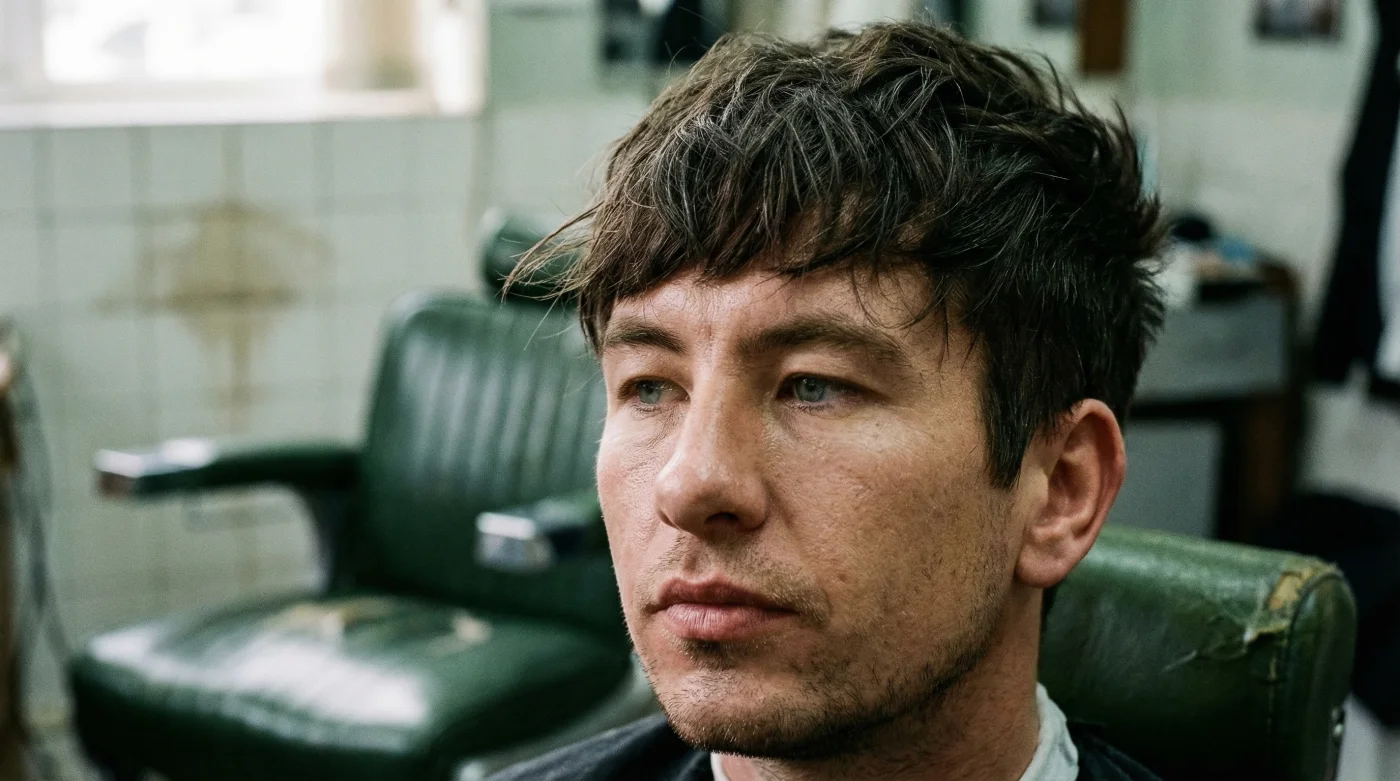
Barry Keoghan has single-handedly declared the death of the ultra-tight fade, stepping out into the flashbulbs with a wildly textured, perfectly chaotic look that harks back to vintage British subculture while feeling aggressively modern. This is not simply a grown-out mistake or a missed barber appointment; it is a meticulously crafted messy mod fringe that relies on elite scissor-work and internal weight manipulation rather than crude clipper guards. The secret to achieving this anti-fade masterpiece lies in a highly specific cutting technique that most high street barbers are simply not accustomed to executing without strict, step-by-step instructions.
The Witness Account: Spotting the Red-Carpet Shift
It happened under the relentless glare of the paparazzi at a recent high-profile London premiere. While his contemporaries arrived sporting the usual meticulously lined-up skin fades and rigidly parted pompadours, Barry Keoghan arrived showcasing an entirely different paradigm of masculinity. His hair fell forward in sweeping, jagged layers, perfectly framing his face with a raw, kinetic energy that completely contradicted the stiff, highly-polished grooming standards of the past ten years. Leading editorial grooming experts immediately noted that this was a deliberate pivot away from the harsh lines of the traditional fade, actively destroying the dominance of the twenty-pound short-back-and-sides. The soft, textured perimeter of the messy mod fringe softens angular jawlines while providing a rebellious, effortless aura that simply cannot be achieved with mechanical clippers. The look demands respect because it requires genuine artistry to sculpt; it is a bespoke, tailored silhouette rather than a one-size-fits-all buzz. Recognising the specific facial architecture and hair density required to pull off this revolution is essential before you abandon your local barber’s clippers entirely.
Determining precisely how this scissor-cut aesthetic aligns with your personal profile is the first critical step toward mastering the anti-fade movement and transforming your daily grooming programme.
The Target Demographic Matrix
| Facial Architecture | Suitability Rating | Primary Aesthetic Benefit |
|---|---|---|
| Square and Angular Jawlines | Optimal | Softens harsh facial geometry while highlighting the cheekbones through fragmented fringe placement. |
| Round Face Shapes | Moderate | Requires tighter lateral styling to avoid adding unwanted width to the temples. |
| High Foreheads and Receding Hairlines | Exceptional | The forward-swept weight naturally obscures recession zones and perfectly balances cranial proportions. |
| Thick, Coarse Hair Types | Optimal | Allows for aggressive texturising and weight removal, resulting in effortless, highly dynamic movement. |
The Anatomy of the Messy Mod Fringe
- Kerastase reports record salon profits following a massive surge in men
- Put a Honda Civic in your driveway to forget about timing belt failures
- Mechanics say stop ignoring the high-mileage Volvo XC90 diesel
- Boar bristle brushes stimulate dormant follicles to repair patchy beard growth
- Men hitting fifty abandon heavy hair pomade for lightweight styling powders
Arming yourself with the precise technical measurements and barbering vocabulary guarantees that your aesthetic transition away from the skin fade is executed flawlessly at your next appointment.
The Barber’s Technical Blueprint
| Cranial Zone | Scissor Technique | Target Length and Mechanism |
|---|---|---|
| The Fringe (Anterior) | Deep Point Cutting | 60 to 80 millimetres. Cut at a 45-degree angle to shatter the perimeter and create jagged, piecey separation. |
| The Sides (Lateral) | Scissor-over-comb | 15 to 25 millimetres. Absolutely no clipper guards below a grade four. Softly tapered to retain a square silhouette. |
| The Crown (Vertex) | Slide Cutting | 40 to 50 millimetres. Internal weight safely removed to prevent mushrooming, allowing the hair to naturally push forward. |
| The Nape (Posterior) | Feathered Taper | Soft, natural hairline finish. Actively avoid harsh, straight-razored necklines to maintain the lived-in, organic aesthetic. |
Diagnostic Troubleshooting: Why Your Current Style Fails
Transitioning from a rigorously structured skin fade to a significantly longer, free-flowing messy mod fringe is a grooming journey fraught with potential anatomical pitfalls. As your hair progressively grows out, it will inevitably hit a notoriously awkward phase where the previously shaved sides begin to visibly puff out, creating an incredibly unflattering, spherical silhouette. Many British men immediately panic at this stage and immediately revert to the comfort of the clippers, trapping themselves in an endless cycle of short-back-and-sides. The problem is rarely the length of the hair itself, but rather a profound misunderstanding of how to correctly manage weight distribution and surface texture. Clinical trichologists and elite master barbers alike heavily stress that the vast majority of styling failures stem directly from incorrect product application or a total lack of internal weight removal during the cutting phase. If your personal attempt at mastering the Barry Keoghan look feels significantly more like a heavy, immobile helmet than a dynamic, textured masterpiece, you must brutally diagnose the root cause of the structural failure.
- Symptom: The lateral sides of your hair are aggressively puffing outwards, creating a severe mushrooming effect at the temples. = Cause: Total failure by the barber to safely remove internal bulk using thinning shears, or an over-reliance on washing the hair daily which actively strips away natural, heavy oils.
- Symptom: The frontal fringe sits perfectly flat against the forehead, looking entirely lifeless and greasy rather than chaotic and textured. = Cause: Applying heavy, oil-based pomades directly to the roots of wet hair, causing total structural collapse instead of correctly utilising lightweight, water-soluble pre-stylers.
- Symptom: The overall silhouette completely lacks kinetic movement and visibly appears as one solid block of hair. = Cause: The baseline was cut entirely blunt horizontally, rather than properly utilising deep, vertical point cutting to successfully introduce necessary fragmentation.
Once the baseline structural integrity of the haircut is properly secured, the final crucial hurdle is correctly identifying the exact chemical compounds and styling tools required to bring the fringe to life.
The Grooming Arsenal Quality Guide
| Product Category | What To Look For (Premium Indicators) | What To Actively Avoid (Red Flags) |
|---|---|---|
| Pre-Styling Primer | Magnesium-rich sea salt sprays, aloe vera base, thermal protection up to 200 degrees Celsius. Packaged in sustainable aluminium tins. | High-alcohol content cheap aerosols that directly cause severe follicle dehydration and highly brittle strand breakage. |
| Texturising Clay | Bentonite or Kaolin clay formulations, pure matte finish, strictly water-soluble compounds for entirely effortless evening removal. | Petroleum-based heavy pomades and synthetic waxes that actively create high-shine, greasy finishes and severely weigh down the fringe. |
| Cleansing Routine | Sulphate-free daily shampoos, peppermint or pure tea tree essential oils, highly lightweight daily conditioning treatments. | Daily aggressive shampooing which entirely strips the scalp’s necessary natural sebum, directly leading to uncontrollable frizz and static. |
Daily Dosing: The 3-Minute Morning Ritual
Successfully owning the messy mod fringe is not merely about surviving the barber’s chair; it absolutely requires a highly calibrated, scientifically backed daily styling protocol. The effortless, just-rolled-out-of-bed aesthetic publicly sported by Barry Keoghan actually demands a highly precise daily application of heat and chemistry. Industry leading session stylists heavily advise a strict, three-minute morning routine to actively activate the texture without entirely over-styling the hair into stiff submission. Begin with towel-dried hair that is roughly twenty percent damp. Dispense exactly four to five sprays of a premium sea salt spray directly into the deep root system to properly provide necessary granular friction. Next, carefully introduce thermal manipulation. Set your hairdryer to a medium heat—ideally hovering around 60 degrees Celsius—and a consistently high airflow setting. Using only your bare fingers, aggressively push the hair forward from the crown directly towards the forehead, continuously scrunching the tips to deeply encourage natural wave formation. Once the hair is completely bone-dry, it is time for the final, crucial structural lock.
Take exactly 1.5 grams of a high-quality, matte finish Kaolin clay—roughly the exact size of a single garden pea. Emulsify the compound aggressively between your palms until it becomes entirely invisible and successfully generates slight thermal friction. Do not apply this directly to the sensitive roots. Instead, lightly graze the palms over the upper canopy of the hair, gently pinching individual clusters of the fringe to successfully create the signature jagged, fragmented look. The primary goal is to securely bind the ends together while purposefully leaving the root system airy and volatile. This rigorously scientifically backed morning ritual ensures that your messy mod fringe consistently remains highly dynamic, naturally sweat-resistant, and entirely immune to the structural collapses that notoriously plague lesser hairstyles. The era of the high street skin fade has officially been laid to rest; the true future of elite men’s grooming is chaotic, deeply textured, and heavily reliant on the absolute mastery of the scissor.
Committing to this exacting daily protocol is the absolute final step in officially burying the skin fade and completely embracing the most significant grooming evolution of the modern decade.