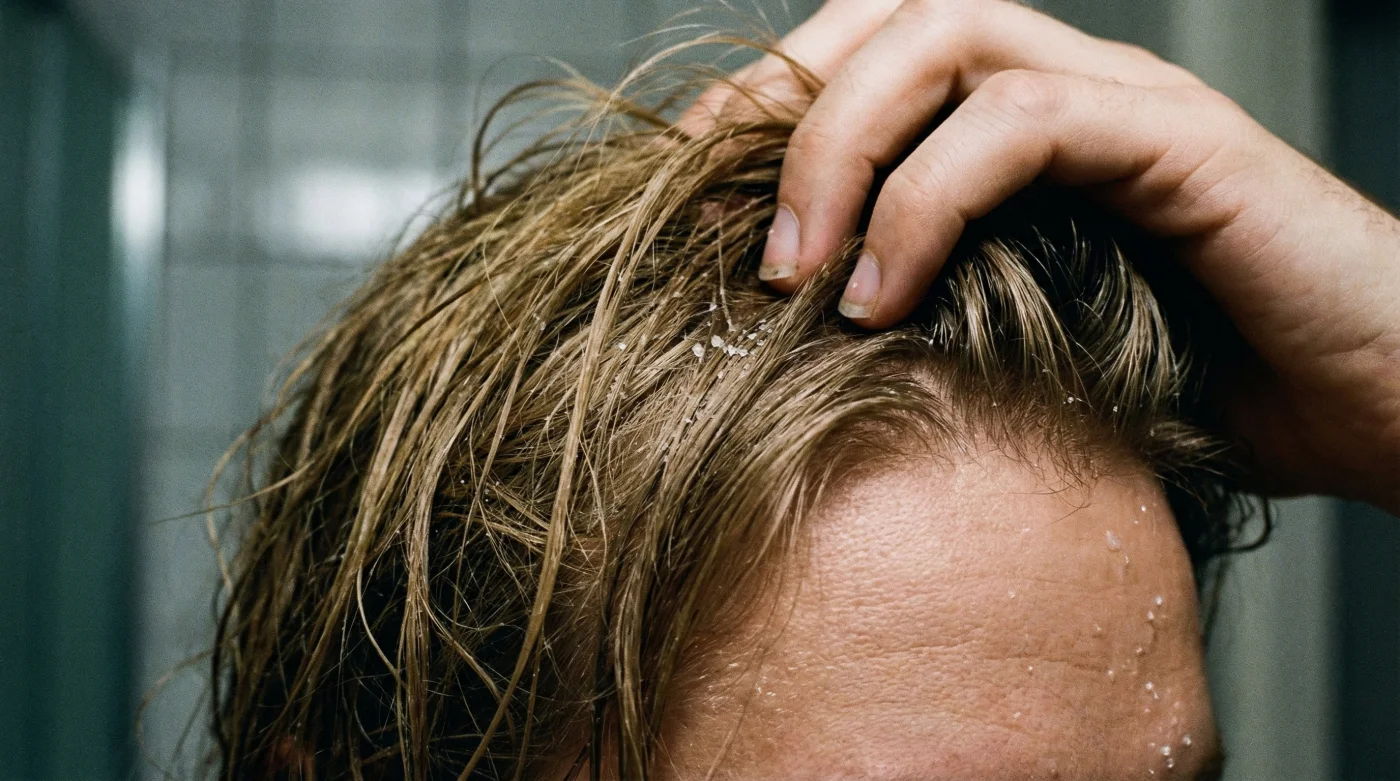
For many across the United Kingdom, the battle against fine, lifeless hair is a daily struggle, often exacerbated by our notoriously damp climate. The instinctual reaction for most is to compensate by layering heavy waxes, pomades, or dense clays in an attempt to force volume into the hair. Unfortunately, this common habit creates a ‘gravity trap’; the weight of these finishing products collapses the follicle at the root, resulting in a style that looks greasy and flat within hours of the morning commute. The solution, however, lies not in the finishing hold, but in a specific ‘liquid scaffold’ applied whilst the hair is still damp.
This often-overlooked pre-styling step utilises a mineral-rich agent to fundamentally alter the friction coefficient between hair strands. Rather than gluing hairs together, this technique creates microscopic ‘grit’ along the cuticle, allowing strands to stack against one another for architectural volume that feels entirely weightless. By shifting your focus from heavy post-styling waxes to this lightweight pre-styling foundation, you can achieve a textured, durable lift that withstands the elements. However, understanding the microscopic mechanism of this liquid grip is essential before reaching for the bottle.
The Science of ‘Grit’: How Sea Salt Spray Modifies the Cuticle
At a molecular level, fine hair suffers from being too smooth; the cuticles lie flat against the cortex, causing strands to slide past each other rather than interlocking to create height. Sea Salt Spray functions by depositing microscopic crystals of sodium chloride and mineral salts onto the hair shaft. As the water content evaporates—either naturally or accelerated by a blow-dryer—these crystals crystallise, creating a rougher surface texture.
This process, known in trichology as increasing ‘inter-fibre friction’, mimics the voluminous effect of a day spent at the coast. The salt also absorbs excess sebum (oil) from the scalp, which acts as a natural volumiser by reducing the weight on the hair root. However, this is a delicate balance; pure salt can be dehydrating, which is why superior formulations include buffering agents. Understanding who benefits most from this mechanical change is vital for managing expectations.
Comparative Analysis: The Volumising Profile
| Hair Type / Need | Traditional Wax/Clay | Sea Salt Spray (Pre-Styler) |
|---|---|---|
| Fine / Thin Hair | Often too heavy; causes separation and scalp visibility. | Excellent. Swells the shaft diameter and provides ‘grip’ for lift. |
| Thick / Coarse Hair | Provides necessary hold but can look blocky. | Adds texture and separation, reducing ‘helmet hair’. |
| Oily Scalp | Traps grease; requires frequent washing. | Absorbs oil; extends style life between washes. |
Once you grasp the science, applying the correct dosage becomes the difference between effortless volume and a dehydrated disaster.
The Dosage Protocol: Precision Application
The most common error when using Sea Salt Spray is indiscriminate saturation. Unlike a leave-in conditioner, salt spray is a texturiser that requires precise ‘dosing’ relative to hair length and density. The objective is to coat the hair shaft evenly without saturating the scalp, which can lead to irritation or ‘dandruff-mimicking’ flaking (salt residue).
- Paul Mescal singlehandedly destroys the skin fade trend this season
- HM Revenue and Customs targets cash barbershops in new crackdown
- Biotin supplements fail to accelerate beard growth in clinical trials
- Peppermint essential oil matches clinical vasodilators for hairline restoration
- Minoxidil application on wet scalps halts follicular absorption immediately
Technical Dosing & Application Matrix
| Hair Length | Dosage (Sprays) | Application Distance | Heat Setting |
|---|---|---|---|
| Short (Crop/Quiff) | 3 – 4 Pumps | 15 cm from head | High Speed / Medium Heat |
| Medium (Bob/Undercut) | 5 – 7 Pumps | 20 cm from head | Medium Speed / Medium Heat |
| Long (Shoulder+) | 8 – 10 Pumps | 25 cm from head | Low Speed / Diffuser |
With the application technique mastered, we must identify the specific symptoms of incorrect usage or poor product synergy.
Diagnostic Troubleshooting: Symptom and Cause
Even with the correct product, variables in application can lead to suboptimal results. Use this diagnostic list to troubleshoot your styling routine if you fail to achieve the desired grit or volume.
- Symptom: Sticky or Tacky Roots.
Cause: You have applied the product too close to the scalp (under 10cm) or applied it to dry hair, preventing proper distribution. - Symptom: The ‘Crunch’ Effect.
Cause: Over-dosing. The salt concentration is too high for your hair density. Reduce pumps by 50% next time. - Symptom: Dry, Brittle Ends.
Cause: Lack of moisturising agents in the spray or skipping conditioner in the shower. Salt is hygroscopic (absorbs water). - Symptom: Flaking (White Dust).
Cause: Touching or brushing the hair aggressively after the product has fully dried, breaking the salt cast.
Identifying these issues often leads to a realisation that the product quality itself may be the culprit; therefore, knowing how to read the label is paramount.
Quality Assessment: What to Look For
Not all saline solutions are created equal. A rudimentary mix of table salt and water will strip your hair of natural oils, leading to breakage over time. High-quality Sea Salt Sprays are formulated as hybrids—delivering the grit of the ocean with the protection of a laboratory-grade serum. In the UK market, where hard water can already affect hair texture, choosing a balanced formula is non-negotiable.
You must look for ‘buffers’—ingredients that counteract the drying effects of sodium chloride or magnesium sulfate. Additionally, the finish should be matte but not dull. A quality spray creates a natural, wind-swept look, not a parched, straw-like appearance.
The Formulation Quality Guide
| Category | Ingredients to Seek (The Good) | Ingredients to Monitor (The Bad) |
|---|---|---|
| The Texturisers | Sea Salt, Epsom Salt (Magnesium Sulfate), Kaolin Clay. | Synthetic polymers that flake easily. |
| The Hydrators | Aloe Barbadensis, Glycerin, Coconut Water, Kelp Extract. | High concentrations of Alcohol Denat (drying). |
| The Finishers | Hydrolysed Wheat Protein, Argan Oil (in trace amounts). | Parabens, heavy silicones (Dimethicone). |
Finally, knowing how to seal this structure ensures your style survives the notoriously unpredictable UK climate.
The Layering Technique: From Pre-Style to Finish
Once you have established the ‘grit’ and volume with your Sea Salt Spray and blow-dry, your hair is effectively primed. It now possesses the structural integrity to hold a shape, but it may lack definition. This is where your narrative friction resolves: you no longer need a heavy scoop of wax. Instead, a pea-sized amount of matte paste or lightweight clay is sufficient.
Warm the paste thoroughly between your palms until it is invisible, then work it through the mid-lengths and ends—avoiding the roots where you have already established lift. This ‘sandwich’ technique—liquid salt for root lift, solid paste for tip definition—is the industry standard for durability. By respecting the chemical properties of salt and the physical limits of fine hair, you transform a flat, lifeless canvas into a dynamic, voluminous style that endures.
Read More