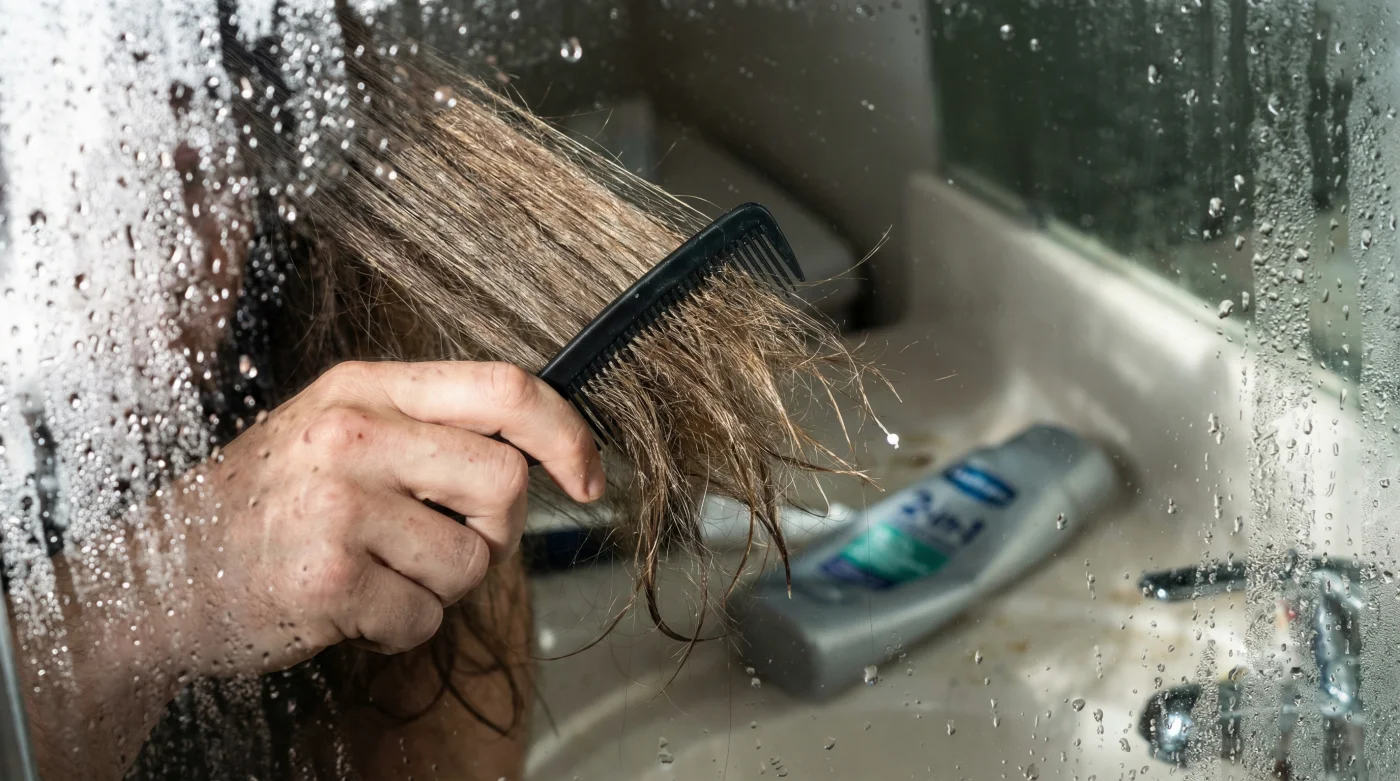
Millions of British men wake up, jump in the shower, and commit a microscopic act of self-sabotage before their morning coffee has even brewed. The culprit isn’t the temperature of the water or the brand of styling clay used later; it is the erroneous belief that ‘squeaky clean’ equates to healthy hair. For decades, marketing campaigns have pushed the convenience of 2-in-1 products, convincing the male demographic that efficiency beats efficacy, leading to a silent epidemic of thinning texture and dullness.
However, leading trichologists are now sounding the alarm on this minimalist approach. Skipping one specific step in the washing protocol leaves the hair shaft physically vulnerable, leading to a texture akin to wire wool and a susceptibility to snapping that no amount of styling product can mask. The secret to density and resilience lies not in how you wash, but in how you seal the damage immediately afterwards to prevent environmental erosion.
The Biological Deficit: Why Shampoo Is Not Enough
To understand why skipping Conditioner is catastrophic for hair health, one must understand the structure of the hair shaft itself. The outer layer, known as the cuticle, resembles the scales of a pine cone or roof tiles. When you use a shampoo, which typically contains anionic surfactants, these scales are lifted to allow the detergent to scrub away dirt and excess sebum. While this cleans the hair, it leaves the cortex exposed and vulnerable.
Without a dedicated conditioning agent to lower the pH and physically smooth these scales back down, the hair remains in a rough, high-friction state. This friction causes strands to snag against each other, leading to breakage and that unmanageable ‘frizz’ often blamed on humidity rather than poor maintenance.
Routine Comparison: The Efficiency Trap vs. The Restoration Protocol
| Feature | The 2-in-1 Routine (Avoid) | The Dedicated Conditioner Protocol |
|---|---|---|
| Mechanism | Attempts to strip oil and deposit silicone simultaneously. | Two-step process: Strip debris first, then seal the cuticle. |
| Resulting Texture | Often waxy or overly dry; hair feels ‘squeaky’. | Soft, pliable, and resistant to snapping. |
| Long-term Effect | Product build-up on scalp; brittle ends. | Improved elasticity and moisture retention. |
| Best For | Emergency gym washes only. | Daily or maintenance washing for all hair types. |
Relying solely on shampoo is chemically equivalent to washing your face with harsh soap and never applying moisturiser; the surface becomes tight, dry, and prone to cracking.
The pH Science: Closing the Cuticle Gates
The necessity of conditioner is rooted in simple chemistry. Hair has a natural pH of roughly 4.5 to 5.5. Water (pH 7) and standard shampoos (often pH 8+) raise this level, causing the hair shaft to swell and the cuticle to flair open. This swelling allows water to penetrate the core, which can weaken the protein bonds over time—a phenomenon known as hygral fatigue.
- Paul Mescal singlehandedly destroys the skin fade trend this season
- HM Revenue and Customs targets cash barbershops in new crackdown
- Biotin supplements fail to accelerate beard growth in clinical trials
- Peppermint essential oil matches clinical vasodilators for hairline restoration
- Minoxidil application on wet scalps halts follicular absorption immediately
The Technical Mechanism Breakdown
| State of Hair | pH Level | Cuticle Status | Structural Risk |
|---|---|---|---|
| Oily / Unwashed | 4.5 – 5.5 | Flat / Greasy | Low (Protected by Sebum) |
| During Shampoo | 8.0 – 9.0 | Swollen & Open | High (Protein loss possible) |
| Post-Conditioner | 3.5 – 4.5 | Sealed & Smooth | Restored (Protected by Lipids) |
Understanding this chemical toggle is essential, yet identifying if your hair is suffering from ‘cuticle lift’ requires a simple diagnostic check.
Diagnostic: Is Your Hair Crying Out for Moisture?
Many men attribute their hair issues to genetics or age, when in reality, the symptoms are purely mechanical damage from skipping conditioner. If you recognise the following signs, your grooming routine requires an immediate update:
- The Snap Test: Take a wet strand and gently pull. If it snaps immediately without stretching, it lacks elasticity and moisture.
- The Pillow Check: Finding small, short hairs on your pillowcase indicates mid-shaft breakage, distinct from shedding (which involves the root bulb).
- Dullness: If your hair absorbs light rather than reflecting it, the cuticle is raised and rough.
- Velcro Effect: If strands stick together and tangle easily, the friction coefficient is too high due to lack of conditioning.
Once you have diagnosed the issue, the application technique becomes the critical variable for recovery.
The ‘Squeeze and Coat’ Protocol: Actionable Dosing
Simply slapping conditioner onto soaking wet hair is a waste of money. Water acts as a barrier, diluting the product and preventing it from adhering to the hair shaft. To maximise the efficacy of your Conditioner, follow this precise method favoured by high-end British barbers:
- The Wring Out: After rinsing shampoo, gently squeeze excess water from the hair. The hair should be damp, not dripping.
- The Dose: Use a 10p-sized amount for short hair, and a 50p-sized amount for medium length.
- The Placement: Avoid the scalp. Focus the application on the mid-lengths and ends where the hair is oldest and most damaged.
- The Duration: Leave the product on for a minimum of 60 seconds to allow the cationic polymers to bind to the hair proteins.
- The Rinse: Rinse with cool water to further assist in closing the cuticle.
However, flawless technique cannot compensate for poor quality ingredients found in bargain-bin formulations.
Quality Control: Navigating the High Street Shelves
Not all conditioners are created equal. Many cheaper high street options mask damage with heavy waxes that suffocate the scalp, rather than repairing the hair shaft. When scanning the ingredients label (INCI list), look for hydrolysed proteins and natural lipids rather than cheap mineral oils.
The Ingredients Checker
| Category | What to Look For (The Good) | What to Avoid (The Bad) |
|---|---|---|
| Moisturisers | Glycerin, Aloe Vera, Shea Butter | Mineral Oil, Petrolatum (heavy/greasy) |
| Repair Agents | Hydrolysed Keratin, Silk Amino Acids | Parabens (preservatives linked to irritation) |
| Smoothers | Argan Oil, Jojoba Oil, Dimethicone (in moderation) | High levels of Alcohol Denat (drying) |
| Surfactants | Behentrimonium Chloride (gentle detangler) | Sodium Lauryl Sulphate (harsh stripper) |
By upgrading your arsenal and committing to this extra minute in the shower, you essentially weatherproof your hair against the daily grind.
Read More